Monday, January 7, 2008

What the Bleep do We Know!?

The following are my thoughts on the movie "What the Bleep do We Know!?"


The phrase, "down the rabbit hole" originated in Lewis Carroll's book "Alice's Adventures in Wonderland," a work of fiction that is traditionally categorized as "nonsense literature." Therefore, it seems appropriate that many 9/11 conspiracy theorists use this phrase when delving deeply into their convoluted theories that will "blow your mind" and, unfortunately, the same seems to be true for the inclusion of the phrase in the subtitle for the 2004 film "What the Bleep do we know!?"


The general theme of the film appears to be a scientific affirmation of a certain mystical philosophy, and it is bookended with statements alluding to a forthcoming merger between science and religion. Unfortunately, the science presented as evidence of this throughout the film is more speculative fantasy than scientific reality.


The basis for the thesis (or at least the closest thing to one that the film gets) presented in the film is that quantum mechanics proves that the effect of an observer being present is a necessary part of the equation. As evidence they present the results of the "double-slit experiment"

http://en.wikipedia.org/wiki/Double-slit_experiment


where the results of single photons passing though two slits changed from a wave-like pattern to a particle-like pattern when the path of the photons passing through the slits was being monitored. The philosophy presented in the film is that when no observer is present, there only exists infinite possibilities, and it's only when a conscious observer e
nters the equation that a specific reality exists. The filmmakers postulate that if a conscious observer is necessary for reality to exist, then humans literally create reality with thoughts. I have two big problems in buying this philosophical idea:


  1. Anyone familiar with the "double-slit experiment" knows that the effect of the measurement itself is only one of many possibilities scientists have formulated to explain the results they were seeing; it is not a legitimate scientific theory because it cannot be falsified. Attempting to prove or disprove it involves a Catch-22: One cannot prove that an object behaves differently when not being observed without observing the behavior of the object.
  2. Quantum mechanics deals in the sub-atomic world, where Netwon's laws of physics do not apply. In fact, at one point, a talking head in the film specifically states that the sub-atomic world is "a fantasy created by mad physicists trying to figure out what the heck is going on when they do these little experiments." In other words, the theoretical sub-atomic world has no connection with the rules of physical reality. It is, by definition, theoretical. Yet, this film pulls the observer factor from the theoretical world of quantum mechanics and applies it directly to the physical world in which we move.


So we have a film presenting philosophical views that cannot be proven true or false by legitimate scientific methods. That sounds a lot like religion to me, but there's more to it than that.


The filmmakers literally make a quantum leap from the theoretical sub-atomic world to the tangible physical world, and there is no bridge between them. The closest the film gets to making some sort of connection is to classify human cells as conscious observers.


The point where the film really started to lose me is when they refer to a series of water experiments where human intentions projected into water droplets apparently affected the formation of crystals when the water was frozen. The evidence is so clearly skewed to fit the mold of the film that it just simply cannot be trusted. The "peaceful" crystals are shown in blue while the "angry" crystals are shown in red. Without the color difference both formations would look equally beautiful to me. Further, these are just single crystals in a drop of water. There is no evidence that EVERY crystal in the drop of water formed in a similar way.


When first viewing this film, I was immediately frustrated by the lack of identification of any of the talking heads. Any decent documentary shows the qualifications of the person speaking as they are doing so. If someone is explaining how human thought has the ability to literally create reality, I think it would be helpful to know whether this person has some legitimate qualifications in the field about which they are speaking, or if they are a Burger King employee who was struck with a life-altering revelation while changing the French-fry oil. Throughout the duration of the film, "What the Bleep" never gives so much as these people's names…..at least not until the credits roll…. And then it's a real eye-opener.


One of the talking heads in particular caused my brow to furrow more than once. She is a blond wearing a somewhat unusual red outfit, and is filmed from a slightly uncomfortable level of close-up (much closer than the rest of the experts on camera). She speaks in somewhat fragmented sentences with a vague accent that seems to come and go depending on what she is saying at the time… and she gets a lot of screen time throughout the film. When the credits come to identifying her, they read as follows:

Ramtha
Master Teacher – Ramtha School of Enlightenment
Channeled by JZ Knight


When I read this I had to immediately stop the film and do a Google search on JZ Knight and Ramtha. It turns out that although I thought I was simply listening to a mysterious woman with an unusual method of speaking, in reality I was hearing the voice of Ramtha, a warrior spirit from Atlantis who lived some 35,000 years ago, being channeled by Judy Zebra Knight. The more I read about JZ Knight and Ramtha the more I came to see this film less as actual science and more as propaganda for Knight's new-age religion.


This feeling deepened when I discovered that the three filmmakers, William Arntz, Betsy Chasse and Mark Vicente, are also all members of the Ramtha School of Enlightenment, as are several of the experts they interviewed. Among the other experts we have a chiropractor who has discovered the ability to create his own reality, an anesthesiologist, and a few people who actually happen to be some form of scientist.


David Albert is among the legitimate scientists presented in the film, and is the first one presented in the extended interviews on the reverse of the DVD. After watching the interview and then viewing the movie a second time it is clear that in no way does he endorse the message of the film. In fact, since the film's release, Albert stated:


"I was edited in such a way as to completely suppress my actual views about the matters the movie discusses. I am, indeed, profoundly unsympathetic to attempts at linking quantum mechanics with consciousness. Moreover, I explained all that, at great length, on camera, to the producers of the film ... Had I known that I would have been so radically misrepresented in the movie, I would certainly not have agreed to be filmed."


Another of the talking heads in the film with actual scientific knowledge is John Hagelin, but he has some unusual credentials. The school at which he teaches is the Maharishi International University, founded by Maharishi Mahesh Yogi, creator of the Transcendental Meditation technique. There's nothing particularly wrong with that, but if the principals discussed in "What the Bleep" had actual scientific merit, one would think that a more mainstream source could be found to confirm them.


Another of the legit scientists, Jeffrey Satinover, is author of "The Gay Gene" and claims to have the ability to "cure" homosexuals.


Michael Ledwith is one of the main people in the film making a connection between scientific and religious concepts. He is a former Catholic priest, who resigned his position amid controversy surrounding statements about Jesus's twin brother and accusations of child molestation, but by the time "What the Bleep" was made, he had found a position teaching at the -- you guessed it – Ramtha School of Enlightenment.


Fred Alan Wolf is probably the closest to an actual legitimate scientist who represents the views presented in "What the Bleep," and despite his wild, wavy white hair, he appears to me as the least crazy person in the film as well as its most endearing character. It is important to recognize that his official title is "theoretical physicist," and he is the one who explains the subject matter in which he deals as a "fantasy created by mad physicists." It is also important to emphasize that none of the legitimate scientists shown in this film suggest that actions in the quantum world have any bearing on actions in the physical world (such as people creating their own reality). The science presented in "What the Bleep" is fallacy, but it does match identically the teachings presented as fact by the Ramtha School of Enlightenment.


In actuality, "What the Bleep" is a marketing tool for JZ Knight and her "school." It's basically her equivalent of sending a Jehovah's witness to your door. Of course that does not necessarily make it a dangerous or even bad thing. The basic message of the film, in essence: "Think positively and you will change your life for the better," is not destructive in casual use. Of course, when taken to an extreme it could be dangerous. For example Knight's ex husband apparently sued her for delaying his treatment for HIV claiming that she could cure him on her own. To be fair, almost anything taken to an extreme is dangerous and I think that there is nothing essentially wrong with the message that this film delivers. What is dangerous is the deception involved. I doubt that many people viewing "What the Bleep" are aware that it is not so much science as pseudoscience. It is, in fact, a work of fiction, much like The Celestine Prophecy (a book written in 1993 that also predicted a merger of science and religion), but it presents itself as a genuine look at quantum mechanics.


While both the Celestine Prophecy and "What the Bleep" provide some interesting food for thought, anyone who bases a religious philosophy on these fantasies is certainly no better off than a member of any traditional religion.


My theory on the current state of scientific knowledge is that it is the equivalent of an early stage in a role-playing computer game where you are presented with a primarily black map and are only able to see the area immediately around you. As your characters explore the world, more of the map is illuminated and you know more about your world. Of course as our sphere of knowledge increases, so does our awareness that there is more out there that we do not understand. The larger the circle becomes, the larger the perimeter between the known and unknown is and our list of unanswered questions grows.... and we have no idea how large the black area actually is. I believe that building a religion on what is currently known to scientists (or in the case of atheists, what is unknown to scientists) is a mistake.


At the end of Lewis Carroll's story it is revealed that the entire sequence of events is an illusion. It's seems immensely ironic when wide-eyed conspiracy theorists lay out a trail of nonsensical paranoia in front of me and then ask me how far down the rabbit hole I want to go.


When looking at these people, who are typically shifty folks with nervous twitches and rapidly shifting eyes living in an underground bunker somewhere, I often think that if this is what it's like to be awake and enlightened, then I'd rather just hit the snooze button.


Andrew Meyer, the University of Florida student who earned his 15 minutes of fame with the catch phrase, "Don't taze me, bro!" is well on his way to becoming one of these people. Because of his delusional view of reality, he behaves irrationally at events like the John Kerry Q&A, which brings on things like the "tazing" which further deepens his paranoia. He is being sucked down the rabbit hole, and the conspiracy book he's clutching is a poor substitute for a Saint Christopher Medal.


Instead of a bleary-eyed college student, "What the Bleep" has a young boy with a basketball, but regardless of what entrance you take into the rabbit hole, it's a good idea to not be too cavalier about jumping into the darkness. One should always view whatever they see in a rabbit hole with a healthy dose of skepticism.


Both 'What the Bleep" and the 9/11 conspiracy film "Loose Change" very convincing if you approach them with naive trust. However, if the viewer exercises a little critical thinking, does some fact checking, and pays particular attention to who exactly is making the claims presented, they should not fall victim to any deception.


Most 9/11 conspiracy films contain people claiming to be "experts" such as "civil engineers" who explain how the collapse of the World Trade Center towers could only have been accomplished through the intentional detonation of explosives in the buildings. Of course they hide their true credentials. One prominent Civil Engineer in the 9/11 truth movement is in fact a golf course manager. The 9/11 Truth movement is full of people who happen to have the word "engineer" in their title speaking outside of their realm of expertise. There are dentists, water testers, architects and so on... but not a single qualified structural engineer supports their theories.


"What the Bleep" is very similar. It too contains footage of people speaking outside their level of expertise, such as a chiropractor explaining how the neural network of your brain functions. While this particular doctor of chiropractic medicine may in fact have extraordinary knowledge about neural networks, if the theories he is presenting had much merit there would surely be some legitimate neural experts whom the filmmakers could use instead to give the argument more credibility. As it stands, "What the Bleep" is extremely lacking in that department.

-------------------------------

You can read my review of 9/11 conspiracy film "Loose Change" via the archive on my myspace blog - The Loose Change blog was posted on myspace 03/12/06

Wednesday, December 26, 2007

Borda vs. Range voting

This is a repost of a blog originally posted on my myspace blog 07/05/07:

This is an expansion of a topic that came out of Mike's blog a while back. With the stink raised by sore losers in the two most recent Presidential elections, our online discussion involved alternative voting methods that might produce a fairer vote count. In this blog I will compare the current majority method of tabulating election results with two alternatives: Borda and Range.

To compare these methods, I will use a typical Presidential election with two strong candidates, the Republican #1 and the Democrat #2, and a weaker independent #3 as the available choices. I am assuming that the voter base is split 50/50 between left and right wing supporters, and that the independent candidate has more support from the left than the right.

ELECTION #1 – majority vote counting –

Listed as:

Voter: Vote

01: #1
02: #2
03: #3
04: #1
05: #1
06: #2
07: #2
08: #1
09: #2
10: #1

Results:
Candidate #1 - 5 votes
Candidate #2 - 4 votes
Candidate #3 - 1 vote

Candidate #1 wins.

The complaint with this system is that only half of the people voted for candidate #1, and so 50% of the voters are supposedly unhappy with the result. We don't know which candidate the voters liked second best, so we cannot be sure that these results show which candidate actually had the strongest support from all of the voters. If we assume that a person voting for candidate #1 hated the other two, and likewise for those voting for #'s 2 and 3, then the results would be fair. However, what if candidate #2 is still moderately liked by those who vote for candidate #1, while candidate #1 is strongly disliked by those who vote for #2? In this case, #2 would have wider support and would rate higher overall among all voters than #1, but #1 would still win the election. This doesn't seem fair.

A proposed alternative that addresses this issue is the Borda method, where the candidates are ranked in order of preference by each voter, allowing voters to select both a first choice as well as a second and third alternate and so on depending on how many choices there are total. In an election with three choices, the candidates get 3 points for a top ranking, 2 for second place and 1 for third place.

ELECTION #2 – Borda vote counting – For this election we will assume that:
Candidate 1 has strong support from the right and moderate support from the left
Candidate 2 has strong appeal to the left and moderate support from those on the right
Candidate 3 has moderate support from the left and virtually no support from the right.

Listed as:

VOTER: 1st CHOICE, 2nd CHOICE, 3rd CHOICE

01: #1, #2, #3
02: #2, #1, #3
03: #3, #2, #1
04: #1, #2, #3
05: #1, #2, #3
06: #2, #1, #3
07: #2, #3, #1
08: #1, #2, #3
09: #2, #3, #1
10: #1, #2, #3

Results:
Candidate 1 - 22 points
Candidate 2 - 24 points
Candidate 3 - 14 points

Candidate #2 wins.

This appears to be better than the majority method because although more people placed candidate #1 in the top spot than did #2, every single voter got either their first or second pick elected, indicating that even if they didn't get the guy they wanted most, they will still be "OK" with the guy in office, because the candidate with the most overall support wins.

However, this scenario assumes that the Republican still has moderate support from those on the left and vice versa, which is not typically the case. Most of the time, the left and right are strongly opposed to the candidate from the other major party, and this is where problems with the Borda system become apparent. A more realistic scenario is that #1 has strong support from the right and virtually no support from the left, #2 has strong support from the left and virtually no support from the right, and #3 has moderate support from the left and virtually no support from the right. In strongly polarizing elections such as this, especially if the results are predicted to be very close, voters would exploit the ranking provided by the Borda method in an attempt to give the candidate from the opposing party the lowest possible score, resulting in the following scenario.

ELECTION #3 – Borda vote counting –
Candidate 1 has strong support from the right and virtually no support from the left
Candidate 2 has strong support from the left and virtually no support from the right
Candidate 3 has moderate support from the left and virtually no support from the right.

01: #1, #3, #2
02: #2, #3, #1
03: #3, #2, #1
04: #1, #3, #2
05: #1, #3, #2
06: #2, #3, #1
07: #2, #3, #1
08: #1, #3, #2
09: #2, #3, #1
10: #1, #3, #2

Results:

Candidate #1 - 20 points
Candidate #2 - 19 points
Candidate #3 - 21 points

Candidate #3 wins...

...despite having only moderate support from the left and no support from the right. Because it requires each candidate to be ranked in comparison to the others, the Borda method results in the candidate with the least support winning due to being lumped in the middle between the tactical votes from supporters of the two strong opposing candidates.

The Borda method only works when people vote their honest opinion, but the reality is that they will not do this if they fear their primary choice might lose due to the election being close. They will almost always give the guy whom they want to lose an artificially low score, and the failure of the Borda method is that it puts the "nobody" candidate in the middle by default.

One voting method that contains the advantages of Borda without the danger of artificially high rankings due to tactical voting is the "range" method. Range voting uses a points system to rate candidates. Unlike Borda where a voter arranges candidates first, second and third in order of preference, this system requires voters to rate each candidate individually using a scale from 0 to 99 (or some other high number), a higher rating indicating more preference toward that candidate. Like Borda, the candidate with the highest score is the winner.

ELECTION #4 – range method -
Candidate 1 has strong support from the right and moderate support from the left
Candidate 2 has strong support from the left and moderate support from the right
Candidate 3 has moderate support from the left and virtually no support from the right.

LISTED AS:

VOTER: CANDIDATE #1 SCORE, #2 SCORE, #3 SCORE
01: 99, 50, 10
02: 50, 99, 10
03: 00, 50, 99
04: 99, 30, 20
05: 99, 50, 50
06: 40, 50, 30
07: 40, 99, 50
08: 99, 50, 35
09: 10, 99, 80
10: 99, 75, 25

Results:
Candidate #1 - 635 points
Candidate #2 - 652 points
Candidate #3 - 409 points

Candidate #2 wins

Just as with the Borda method, the candidate with the highest overall support between all voters wins.

If we now use the range method in a scenario where voters are strongly polarized, the voting goes as follows:

ELECTION #5 – range method –
Candidate 1 has strong support from the right and virtually no support from the left
Candidate 2 has strong support from the left and virtually no support from the right
Candidate 3 has moderate support from the left and virtually no support from the right.

01: 99, 00, 00
02: 00, 99, 50
03: 00, 50, 99
04: 99, 00, 00
05: 99, 00, 00
06: 00, 99, 30
07: 00, 99, 50
08: 99, 00, 00
09: 00, 99, 80
10: 99, 00, 25

Results:
Candidate #1 - 495 points
Candidate #2 - 446 points
Candidate #3 - 334 points

Candidate #1 wins.

Note that the 3rd party candidate does not get placed artificially high because the voter does not have to put them in the middle by default. Also, there is no tactical advantage in voting dishonestly because each candidate is rated individually regardless of what votes his opponents receive. In highly polarized elections, the results of range voting appear to resemble the simple majority method.

Both Borda and Range were tested with two differing scenarios. The majority method was only shown once because the results would have been the same regardless of which candidate a voter liked second best. Only the candidate with the most "#1" votes wins in the majority method, which I believe does not produce fair results in cases with two candidates that share moderate support from the opposing party. The Borda method fails in ELECTION #3 where tactical voting skews the results, so it should be ruled out as a fair voting system.

So now the question is: Does the range method produce fair results in ELECTION #5? Just as with the majority vote counting, with the range method we still end up with 50% of the voters who did not see their first choice candidate win. Is this a problem?

If we analyze the data from ELECTION #5, we see the following indications:

Candidate #1:
50% of voters strongly approve
50% of voters strongly disapprove

Candidate #2
50% of voters strongly disapprove
40% of voters strongly approve
10% of voters moderately approve

Candidate #3
40% of voters moderately approve
40% of voters strongly disapprove
20% of voters strongly approve

Even though half of the voters gave the winner a score of 0, from the election data you can also see that the same was true for candidate #2. Therefore, both candidates were disliked equally. However, 50% of voters gave #1 a "99" score while only 40% of voters did the same for candidate #2, showing that candidate #1was liked more than candidate #2. One way to put it is that while the vote was equally negative for both candidates, it was more positive for #1 than it was for #2. In the range voting method, the vote totals are basically an "approval score." In this example, a score of 990 would be a 100% positive approval by all voters. Candidate #1 has a 50% positive approval rating, while candidate #2 has a rating of 45% and candidate #3 gets 29%. The candidate with the strongest approval rating among all voters is the winner.

If we take the same approach in ELECTION #4, we see that the winning candidate has a positive approval rating of 66%, while candidate #1 comes in at 64% followed by #3 with 41%. Therefore, I believe the range voting method does produce fair results in both experiments.

CONCLUSION:

The majority system works in highly polarized elections, but fails when there are two candidates that share support between the parties.

The Borda method addresses the shortcomings of the majority method by allowing voters to rank candidates in order of preference. However, because it requires candidates to be ranked in comparison with each other, it allows the use of tactical voting to produce false results.

Range voting is essentially the same as the Borda method, except each candidate is rated individually. Because the candidates are not compared to each other, it eliminates the flaw that breaks the Borda method.

To the best of my knowledge, no public elections are counted using the range method. Why not?

The Story of the Californian

This is a repost of a blog originally posted on my myspace blog 05/29/07:

THE STORY OF THE CALIFORNIAN

To me, this is one of the most intriguing events during the evening of April 14-15, 1912. The accounts of what happened on the SS Californian have been a source of controversy for the last 95 years. This blog is my attempt to perhaps clear up some of the issues, because the way I see it, most of the disputed claims and debates are irrelevant to the resulting history and the reasons behind it.

To those unfamiliar with the story, the Californian was another ship in the area of the Titanic on the night of the sinking.  As with much of what happened that night, specific details such as the distance between the two ships is not known.  The story presented here was created primarily by combining the testimonies given during the US Senate inquiry by the Californian's Captain Stanley Lord, Chief Officer George Stewart, Second Officer Herbert Stone and apprentice James Gibson, and the Titanic's Fourth Officer Joseph Boxhall, as well as the final report delivered by Lord Mersey after the British enquiry. As with any testimony involving eyewitnesses (and especially in this case where some individuals may have been motivated to conceal certain facts), there are discrepancies and contradictions between these accounts. However, when they are put together they provide the following sequence of events:

Sunday, April 14th, 1912

10:30pm - The Californian comes up on a field of ice, and Captain Lord decides to stop the ship for the night rather than attempt to pass through it in the dark.

11:00pm – Californian's Third Officer Charles Groves observes the lights of another ship coming into view over the horizon off the Californian's starboard side. Due to the amount of light on the ship, Groves believes it is another passenger ship. Captain Lord also sees this other ship steam up, but he does not think it is a passenger ship. He asks the Californian's wireless operator, Cyril Evans, what ships are in the area. Evans replies, "Only the Titanic." Lord tells him to warn the Titanic about the ice. At the time, Jack Phillips is operating the wireless equipment on the Titanic and is trying to work through a backlog of personal messages that have not yet been sent due to equipment problems earlier.  Evans breaks in to the Titanic's communication with the message, "I say old man, we are stopped and surrounded by ice." The interruption is apparently very loud in Phillips' ears, indicating that the two ships are in close proximity. Phillips snaps back with, "Shut up! Shut up! I am busy. I am working Cape Race."

11:30pm – Evans switches off his set and goes to bed.

11:40pm – The Titanic strikes an iceberg. In the process, she makes a hard turn to port in an attempt to avoid the collision. Groves notices that the ship he has been observing has stopped and it appears to him that she has turned out some of her lights, although the change in appearance could be due to it making a quick turn to port.

11:45pm - Lord instructs Groves to attempt contact with the other ship via Morse lamp. Groves can get no answer from the other liner.

Monday, April 15th, 1912

12:00am – On the Californian, Second Officer Herbert Stone takes watch from Groves. Lord heads to the chart room. Groves stops by the wireless room, as he occasionally likes to play with the set. However, Evans is asleep and Groves is not knowledgeable enough to work the receiver on his own. He fiddles with the equipment for a while, then gives up and goes to bed.

12:15am – The Titanic sends her first wireless distress message.

12:25am – The crew on the Titanic start loading lifeboats. Boxhall sees the lights of a ship about "two points off the port bow," and can see her green starboard light.

12:35am – Harold Cottam, the Carpathia's wireless operator, informs his captain that the Titanic needs help. Captain Rostron immediately turns his ship around and heads for the Titanic.

12:45am – The first lifeboat is lowered from the Titanic and the first distress rocket is fired. Over the next 15 minutes, Boxhall fires off four more rockets while he can see the green light of the other ship. On the Californian, Stone has been watching the ship that stopped about an hour earlier. He can see her red port light, and she seems to be pointing north toward him. Stone notices a white flash above the ship, followed by four more before he is joined on the deck by the apprentice. Although The Californian is stopped, she is drifting in the current, and her bow is slowly turning toward the south. Back on the Titanic, Boxhall observes that the other ship appears to be turning toward them. He can now see her red light in addition to the green. Stone notifies Captain Lord that the ship he is watching has been firing rockets. Lord asks if there is any color in them. Stone replies that they are all white. Lord tells Stone to try contacting the vessel with the Morse lamp, and goes back to lie down in the chart room.

1:05am – Apprentice James Gibson joins Stone on the deck of the Californian and is told of the events Stone has seen thus far. Gibson attempts contacting the ship with the Morse lamp, and then looks through his binoculars for a response. Gibson sees the ship fire two more rockets. Because he is watching through his binoculars, he can see the flash of the detonator, followed by the trail of the rocket, ending with a burst of white stars.

1:15am – While Stone and Gibson continue observing the ship, Stone remarks: "Look at her now Gibson, her lights look queer." Gibson agrees: the other ship seems to have "a big side out of the water."

1:30am – On the Titanic, Boxhall can now see only the other ship's red light. He fires one last rocket. He then leaves the bridge to assist with the lifeboats. On the Californian, Stone and Gibson see the ship to the south fire an eighth rocket. Gibson notices that the Californian is continuing to swing with the current, and her bow is now pointing to the west. Gibson notifies Lord that he has now seen a total of eight rockets.

2:05am – The last of Titanic's lifeboats leaves the ship

2:10am - Stone and Gibson on the Californian notice that the other ship seems to be slowly disappearing. Over the next several minutes, her red light disappears, and then all of her lights vanish. It looks to them as if the ship is steaming away. Stone tells Gibson to wake Lord and inform him. Gibson enters the chart room and tells Lord about the events.

2:20am – The Titanic disappears under the water.

2:40am – Stone informs Lord through the speaking tube that the ship is gone and there have been no more rockets.

3:30am - On the Californian, Stone and Gibson now see more rockets. These ones are further to the south and farther away, and they cannot see the ship that is firing them. At this same time, the Carpathia is approaching from the southeast and is firing rockets to let the Titanic know that they are coming. Passengers in the Titanic's lifeboats also first notice the rockets at 3:30am.

4:00am – Chief Officer George Stewart comes on deck and is informed of what Stone and Gibson have seen overnight. Meanwhile, the Carpathia reaches the Titanic's last reported position.

4:10am – The first lifeboat is picked up by the Carpathia

4:30am – Stewart wakes Lord and informs him about the rockets Stone had seen during the night. Captain Lord's response is, "Yes, I know; He's been telling me." Lord gets up and prepares to work out how to proceed through the ice.

5:20am – On instruction from Lord, Stewart wakes Evans and asks him to inquire about the rockets.

5:45am - Evans discovers that the Titanic has sunk.

6:15am – The Californian starts steaming to the Titanic's last reported position. It is very slow going at first as the ship has to navigate through thick field ice.

7:00am – The Californian is out of the ice and proceeding South at top speed.

8:30am – The Californian arrives next to the Carpathia.

8:50am – The Carpathia leaves the area.

10:40am – Californian leaves the area.

For nearly a century, debates have raged on about how far away from the Titanic the Californian actually was, and whether or not she was close enough to make any difference to the loss of life that night. Neither of these things will probably ever be known. However, based on this time line, there are several things that I believe can be considered facts:

1 – The ship seen by the crew of the Californian was the Titanic.

2 – The ship seen by the crew (and some passengers) of the Titanic was the Californian.

3 – The Californian was much closer to the Titanic than was the Carpathia.

Of course, many other things can be inferred from the timeline. My feeling is that even if the Californian had been able to proceed to the scene immediately after the Titanic's first CQD was sent, she would probably still have arrived too late to save any more passengers. Two hours and 15 minutes passed between the first distress transmission and the ship going under. In order for the Californian to be of any help, I think she would have to get there at least a half hour before the Titanic disappeared. According to testimony, it took the Californian more than two hours to reach the wreck site the following morning, which means that even if they had started in that direction at 12:15am, the Titanic would have gone under before they arrived. Of course since the Californian's wireless operator had gone to bed at 11:30, Captain Lord would not have been able to learn of the Titanic's situation until 12:45am when the first rocket was fired, and more accurately, not until he was first notified of the rockets sometime around 1am. This means that the earliest the Californian could have arrived at the scene would be somewhere around 3:15am....if their testimony concerning their progress on the morning of the 15th is correct.

However, this is where the discrepancies start to come in to play. For example, if the Carpathia is used as a reference, the probable distance between the Californian and the Titanic might be much smaller. When she first started heading toward the Titanic, the Carpathia was 58 miles away. She made it to the lifeboats in three and a half hours, giving her an average speed of 15 knots. At 3:30am, Stone and Gibson saw rockets from the Carpathia that were apparently further away to the south than the rockets they saw earlier, and 30 minutes later the Carpathia was at the Titanic's lifeboats. Using Carpathia's speed of 15 knots, she must have been about eight miles from the lifeboats at the time her rockets were seen. Following this logic, because the crew of the Californian noted that the Carpathia's rockets were farther away than the ones they had seen overnight, their ship must have been less than eight miles away from the Titanic when the eight rockets were seen during the night. The Californian's top speed was 13 knots. Therefore, even considering some slow maneuvering through ice, the Californian should still have been able reach the Titanic in less than an hour, which would put her at the scene at least 30 minutes before the Titanic sank.

Those who defend Captain Lord in debates today are of the firm belief that the first interpretation of the time line is more accurate, and use it as an attempt to clear Lord's name. However, it seems obvious to me that whether or not the Californian was close enough to help is irrelevant. The Carpathia wasn't close enough to make a difference in the death toll either. Therefore, the reason that the Carpathia's Captain Arthur Rostron is seen as a hero while Captain Lord is seen as a villain has nothing to do with their distance from the Titanic. Rostron is a hero simply because he got to the survivors first. Since both interpretations still place the Californian closer to the Titanic than the Carpathia was, it is safe to say that if Captain Lord had behaved in a manner similar to that of Rostron, his ship would have arrived at the scene before the Carpathia, and Lord would have been the hero. The reason Lord is labeled the sole bad guy is because he did not take the initiative to help the ship when he was first notified of the rockets. It doesn't matter whether or not he would have been able to get to the Titanic in time. What matters is that he didn't even try.

This brings me to something interesting about the time line that seems to always get ignored, and to me it goes a long way in explaining Captain Lord's actions. According to the time line, Lord first learned about the rockets at around 1am, but did not find out about the Titanic sinking until nearly 6am after the wireless operator was woken up. I don't think I have ever heard anyone question why the wireless officer was woken up at 5:20. Captain Lord didn't think it important enough to wake Evans up at 1am, and Stewart either didn't ask for or at least wasn't granted permission to wake him up when his watch started at 4:00. Normally, Evans would rise at 7am, so why did Captain Lord wait until 5:20am and then rouse the wireless operator just an hour and a half earlier than normal? I think one possible answer sheds some light on the mindset of Captain Lord, both figuratively and literally: At just about that time, the sun would have been coming up.

I believe Captain Lord's failure was his inability to adjust to the changing circumstances overnight. He stopped his ship at 10:30pm on the 14th because he felt it reckless to attempt passing through the ice field in the dark. However, despite the fact that another ship was in distress nearby later in the evening, his attitude did not change. He still refused to move his ship until night had passed. It seems to me that his thinking was if another ship found herself in trouble, it was due to the stupidity of that ship's captain, and he refused to act stupidly himself. We have to remember that to his mind, the Titanic disaster had not yet happened. Therefore, he was still in the frame of mind that was typical of the age: Even though he might have suspected that the ship firing rockets could have been the Titanic, he would have logically assumed that whatever was the matter, it could wait until daybreak because the Titanic could not possibly sink. Meanwhile, he was going to act responsibly and not endanger his own ship. This attitude is corroborated in a statement he made when asked to appear before the Senate: "If I go to Washington, it will not be because of this story in the paper, but to tell the Committee why my ship was drifting without power, while the Titanic was rushing under full speed." To his mind, even in light of the disaster, the most important factor was still that Smith had been careless while he had been careful. He still didn't recognize that what would have been seen as reckless carelessness at 11:39pm was transformed into selfless heroism just one minute later. Captain Arthur Rostron did, and that is why history remembers him as a hero, and Stanley Lord would spend the rest of his life trying to explain why he didn't get there first.

Thursday, December 20, 2007

I think the best TV bloopers are on home shopping channels:

No matter how many times I watch this one it never gets old.  The guy at the end is the best:
---------------

---------------
Next, we get to hear exactly how clear the sound is on this TV.  Anyone familiar with the movie should know what's coming up:
---------------

----------------
Here's another classic.  The caller even tries to cover for it.  One of the hosts blames a "slippery floor" but the fact is that the guy is just a klutz.
-----------------

-----------------
While we're on the subject of ladders.....
-----------------

------------------
Finally, my personal favorite.  This might be the only one that didn't completely kill sales of the product:
------------------
------------------

Last minute Christmas gift ideas

If you're looking for some last minute gift ideas for me, these records might be available at finer yard sales in your area:


And if you can't find them, perhaps this book would work:

Tuesday, December 18, 2007

HD Format wars: The porn factor

For many years I've somewhat jokingly told people that my philosophy on new technology is this: If you want your new device to succeed you need to be able to use it to look at naked people. The Digital Compact Cassette (DCC):

The MiniDisc:
Digital Audio Tape:

are all examples of technology that never really took off... and you can't use any of these formats to store pictures of boobs and butts.. On the other hand, CDROM, DVD and Internet technologies have all been very successful... and are also all useful for looking at porn.


Of course you can legitimately argue that the three failed technologies I listed are strictly audio formats and the three successes are multimedia-capable. Then there is the iPod, which has been a huge shot in the arm for Apple without anyone seeing so much as a single nipple. This is all true, so perhaps I should refine my theory: If you want your new VIDEO technology to succeed, make sure it allows people to see boobies.

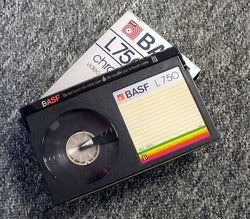
As an example, I present Sony's Betamax.
This was a video format that lost to VHS in the early days of the home video market. Beta had enjoyed an early lead in the home video market and also offered superior picture quality. However, there were more cheap VHS units available than Beta, and a VHS tape offered about twice the recording duration of Beta. As far as home recording went, there was no limitation to what TV shows a person could record on either format, but only VHS allowed the user to tape an entire football game, which was probably the main deciding factor. However, there were other factors that may have played a part in the demise of Beta, including the availability of adult movies on VHS tapes, with X-rated Beta tapes being more rare.

Today, just like in the early days of Beta, Sony's Blu-ray HD format appears to have the lead over HDDVD. Although both formats have identical picture quality, Blu-ray discs are higher capacity making them slightly superior. However, there are currently more inexpensive HDDVD players than Blu-ray players. Also, the adult film industry appears to be leaning toward HDDVD, partially because Sony is offering no Blu-ray support for them. While they are not totally banning porn on their format, they will not allow their disc production facilities to handle adult titles.
http://www.computerworld.com/action/article.do?command=viewArticleBasic&articleId=9008579


Some will probably applaud Sony for discouraging the porn industry from using the Blu-ray format citing their own moral beliefs, but I seriously doubt that any such decisions on the part of Sony were made for moral reasons. Rather, I'd speculate that they are simply trying to avoid negative attention from fringe activist groups and attorneys. Shunning porn may not have been the deciding factor in the death of Beta tapes, but it certainly didn't help the situation, and the same has to be true for Blu-ray discs.


HDDVD and Blu-ray are competing in the free market, and the winning format will be the one with the most money flowing around it, not the one with the strongest moral fiber. No one can deny that there is a lot of cash flowing through the porn industry. Most X-rated DVDs are made on tiny thread budgets and sell for almost twice the price of mainstream DVDs containing films with budgets in the millions. Porn movies are hugely profitable, and if HD porn movies end up being almost exclusively available on HDDVD it can only help that format.


Of course one cannot ignore the extreme differences in the home video market today vs. 30 years ago. It is possible that today's home video market is big enough to support two HD formats.

A sequel of sorts to the Beta vs. VHS battle was fought between two portable video camera tapes over the last 10 years. The Video-8 and VHS-C battle ended in a stalemate because neither format had a clear edge over the other and the camcorder market was able to support both. Given that the two format's spec sheets are nearly identical, this could very well be the case with Blu-ray and HDDVD. We are now a couple of years into this format war with no one able to gain a decisive lead, which could be an indication that both formats might survive. As with the Video-8 and VHS-C comparisons, the major pros and cons to both Blu-ray and HDDVD result in a draw.


While the biggest factor in the Beta/VHS war was recording duration, with Blu-ray vs. HDDVD, it will probably be studio support. All video tape formats allowed anyone to tape and view anything they wanted, and this is not the case with the HD disc formats. There are currently movie studios on both sides of the battle, which means that neither format allows you to watch all of the HD movies on the market. While more movie studios support Blu-ray than HDDVD, the company with the largest market share, Viacom (which includes Paramount, Dreamworks and MTV), is releasing their movies exclusively on HDDVD. Still, this seems to add up to 6 of one / a half dozen of the other, unless you factor in porn. If porn ends up being only available on HDDVD, then the swingers might hold the swing vote.


However, the exact amount of weight porn adds to the HD equation is difficult to determine. While buyers of X-rated VHS tapes had little choice if they wanted to see naked people in motion, today's heavy-breathers can get gigabytes of cheap porn videos instantly on their computers. They don't have to shell out their hard-earned cash to watch a high-def version of the horizontal hokey pokey, and many may not feel that porn on HDDVD is worth the price. Personally, I'm not so sure that HD porn is going to be all that great. I'd think it would be a bit of a buzz-kill to see a nice, sharp image of a porn star that also allows you to count her pimples. Not many adult film producers are going to spend the time or money needed to digitally edit all that stuff out, so HD porn might just be TOO real for my taste. On the other hand, fans of 2girls1cup might relish being able to see the pieces of corn.


Personally, I am rooting for Blu-ray to emerge victorious, and if more consumers choose it over HDDVD it's a given that the adult film industry will follow. However, we are still early enough in the game to where the film producers have more pull than the consumers. One cannot deny that the current situation with the porn industry is a plus for HDDVD. Just how much of a plus is hard to say.


Monday, December 17, 2007

Here is a nice little collection of moments with Santa... My favorite is at the end